
Good Friday
The Lamb of God is sacrificed today for mankind's salvation.

Scripture Readings
First Lesson.1 Osee 6:1-6.
Thus saith the Lord: “In their affliction they will rise early to Me: Come, and let us return to the Lord: for He hath taken us, and He will heal us: He will strike, and He will cure us. He will revive us after two days: on the third day He will raise us up and we shall live in His sight. We shall know and we shall follow on, that we may know the Lord. His going forth is prepared as the morning light and He will come to us as the early and the latter rain to the earth. What shall I do to thee, O Ephraim? What shall I do to thee, O Juda? You mercy is as a morning cloud and as the dew that goeth away in the morning. For this reason have I hewed them by the prophets, I have slain them by the words of my mouth. And Thy judgments shall go forth as the light. For I desired mercy and not sacrifice, and the knowledge of God more than holocausts.”
Second Lesson. Exodus 12:1-11.
In those days, the Lord said to Moses and Aaron in the land of Egypt: “This month shall stand at the head of your calendar; you shall reckon it the first month of the year. Tell the whole community of Israel: On the tenth of this month every one of your families must procure for itself a lamb, one apiece for each household. If a family is too small for a whole lamb, it shall join the nearest household in procuring one and shall share in the lamb in proportion to the number of person who partake of it. The lamb must be a year-old male and without blemish. You may take it from either the sheep or the goats. You shall keep it until the fourteenth day of this month, and then, with the whole assembly of Israel present, it shall be slaughtered during the evening twilight. They shall take some of its blood and apply it to the two doorposts and the lintel of every house in which they partake of the lamb. That same night they shall eat its roasted flesh with unleavened bread and bitter herbs. It shall not be eaten raw or boiled, but roasted whole, with its head and shanks and inner organs. None of it must be kept beyond the next morning; whatever is left over in the morning shall be burned up. This is how you are to eat it: with you loins girt, sandals on your feet and your staff in hand, you shall eat like those who are in flight. It is the Passover of the Lord.
Gospel of the Passion of Our Lord Jesus Christ. John 18:1-40; 19:1-42.
The Apprehension of Jesus
At that time Jesus went forth with His disciples beyond the torrent of Cedron, where there was a garden into which He and His disciples entered. Now Judas, who betrayed Him, also knew the place, since Jesus had often met there together with His disciples. Judas, then, taking the cohort, and attendants from the chief priests and Pharisees, came there with lanterns, and torches, and weapons. Jesus therefore knowing all that was to come upon Him, went forth and said to them: “Whom do you seek?” They answered Him: “Jesus of Nazareth.” Jesus said to them: “I am He.” Now Judas, who betrayed Him, was also standing with them. When, therefore, He said to them I am He, they drew back and fell to the ground. So He asked them again: “Whom do you seek?” And they said: “Jesus of Nazareth.” Jesus answered: “I have told you that I am He. If, therefore, you seek Me, let these go their way”, that the word which He said might be fulfilled: “Of those whom Thou hast given Me, I have not lost one.” Simon Peter therefore, having a sword, drew it and struck the servant of the high priest and cut off his right ear. Now the servant’s name was Malchus. Jesus therefore said to Peter: “Put up thy sword into the scabbard. Shall I not drink the cup that the Father has given Me? The cohort therefore and the tribune and the attendants of the Jews seized Jesus and bound Him. And they brought Him to Annas first, for he was the father-in-law of Caiphas, who was the high priest that year.
Jesus at the Palace of the High Priest
Now it was Caiphas who had given the counsel to the Jews that it was expedient that one man should die for the people. But Simon Peter was following Jesus, and so was the other disciple. Now that disciple was known to the high priest, and he entered with Jesus into the courtyard of the high priest. But Peter was standing outside the gate. So the other disciple, who was known to the high priest, went out and spoke to the portress, and brought Peter in. The maid, who was portress, said therefore to Peter: “Art thou also one of this man’s disciples?” He said: “I am not.” Now the servants and attendants were standing at a coal fire and warming themselves, for it was cold. And Peter also was with them, standing and warming himself. The high priest therefore questioned Jesus concerning His disciples, and concerning His teaching. Jesus answered him: “I have spoken openly to the world; I have always taught in the synagogue and in the temple, where all the Jews gather, and in secret I have said nothing. Why dost thou question Me? Question those who have heard what I spoke to them; behold, these know what I have said.” Now when He had said these things, one of the attendants who was standing by, struck Jesus a blow, saying: “Is that the way Thou dost answer the high priest?” Jesus answered him: “If I have spoken ill, bear witness to the evil; but if well, why dost thou strike Me?” And Annas sent Him bound to Caiphas, the high priest. But Simon Peter was standing and warming himself. They therefore said to him: “Art thou also one of His disciples?” He denied it, and said: “I am not.” One of the servants of the high priest, a relative of him whose ear Peter had cut off, said: “Did I not see thee in the garden with Him?” Again, therefore, Peter denied it; and at the moment a cock crowed.
Jesus before Pilate
They therefore led Jesus from Caiphas to the praetorium. Now it was early morning, and they themselves did not enter the praetorium, that they might not be defiled, but might eat the Passover. Pilate therefore went outside to them, and said: “What accusation do you bring against this man?” They said to him in answer: “If He were not a criminal we should not have handed Him over to thee.” Pilate therefore said to them: “Take Him yourselves, and judge Him according to your law.” The Jews, then, said to him: “It is not lawful for us to put anyone to death.” This was in fulfillment of what Jesus had said, indicating the manner of His Death. Pilate therefore again entered into the praetorium, and he summoned Jesus, and said to Him: “Art Thou the king of the Jews?” Jesus answered: “Dost thou say this of thyself, or have others told thee of Me?” Pilate answered: “Am I a Jew? Thy own people and the chief priests have delivered Thee to Me. What hast Thou done?” Jesus answered: “My Kingdom is not of this world. If My Kingdom were of this world, My followers would have fought that I might not be delivered to the Jews. But, as it is, my Kingdom is not from here.” Pilate therefore said to Him: “Thou art then a king?” Jesus answered: “Thou sayest it; I am a King. This is why I was born, and why I have come into the world, to bear witness to the truth. Everyone who is of the truth hears My voice.” Pilate said to Him: “What is truth?” And when he had said this, he went outside to the Jews again, and said to them: “I find no guilt in Him. But you have a custom that I should release someone to you at the Passover. Do you wish, therefore, that I release to you the king of the Jews?” They all therefore cried out again: “Not this man , but Barabbas!” Now Barabbas was a robber. Pilate, then, took Jesus and had Him scourged. And the soldiers, plating a crown of thorns, put it upon His head, and arrayed Him in a purple cloak. And they kept coming to Him and saying: “Hail, king of the Jews!” and striking Him. Pilate therefore again went outside and said to them: “Behold I bring Him out to you, that you may know that I find no guilt in Him.: Jesus therefore came forth, wearing the crown of thorns and the purple cloak. And he said to them: “Behold, the man!” When, therefore, the chief priests and the attendants saw Him, they cried out, saying: “Crucify Him! Crucify Him!” Pilate said to them: “Take Him yourselves and crucify Him, for I find no guilt in Him.” The Jews answered him: “We have a Law, and according to that Law he must die, because He has made Himself Son of God.” Now when Pilate heard this statement, he feared the more. And he again went back into the praetorium, and said to Jesus: “Where art Thou from?” But Jesus gave no answer. Pilate therefore said to Him: “Dost Thou not speak to me? Dost Thou not know that I have power to crucify Thee, and that I have power to release Thee?” Jesus answered: “Thou wouldst have no power at all over me were it not give thee from above. Therefore, he who betrayed Me to thee has the greater sin.” And from then on Pilate was looking for a way to release Him. But the Jews cried out, saying: “If thou release this man, thou art no friend of Caesar; for everyone who makes himself king sets himself against Caesar.” Pilate therefore, when he heard these words, brought Jesus outside, and sat down on the judgment-seat, at a place called Lithostrotos, but in Hebrew, Gabbatha. Now it was the Preparation Day for the Passover, about the sixth hour. And he said to the Jews: “Behold, your King!” But they cried out: “Away with Him! Away with Him! Crucify Him!” Pilate said to them: “Shall I crucify your King?” The chief priests answered: “We have no king but Caesar.” Then he handed Him over to them to be crucified. And so they took Jesus and led Him away.
The Crucifixion
And bearing the cross for Himself, He went forth to the place called the Skull, in Hebrew, Golgotha, where they crucified Him, and with Him two others, one on each side and Jesus in the center. And Pilate also wrote and inscription and had it put on the Cross. And there was written: “Jesus of Nazareth, the King of the Jews.” Many of the Jews therefore read this inscription, because the place where Jesus was crucified was near the city; and it was written in Hebrew, in Greek and in Latin. The chief priests of the Jews said therefore to Pilate: “Do not write: ‘The King of the Jews’, but: ‘He said: I am the King of the Jews.’” Pilate answered: “What I have written, I have written.” The soldiers therefore, when they had crucified Him, took His garments and made of them four parts, to each soldier a part, and also the tunic. Now the tunic was without seam, woven in one piece from the top. They therefore said to one another: “Let us not tear it, but let us cast lots for it, to see whose it shall be.” That the Scripture might be fulfilled which says: “They divided My garments among them; and for My vesture they cast lots.” These things therefore the soldiers did. Now there were standing by the Cross of Jesus His mother and His mother’s sister, Mary of Cleophas, and Mary Magdalene. When Jesus, therefore saw His mother and the disciple standing by, whom He loved, He said to His mother: “Woman, behold, thy son.” Then He said to the disciple: “Behold, thy mother.” And from that hour the disciple took her into his home.
The Death of Jesus
After this Jesus, knowing that all things were now accomplished, that the Scripture might be fulfilled, said: “I thirst.” Now there was standing there a vessel full of common wine; and having put a sponge soaked with the wine on a stalk of hyssop, they put it to His mouth. Therefore, when Jesus had taken the wine, He said: “It is consummated!” And bowing His head, He gave up His spirit.
The Jews therefore, since it was the Preparation Day, in order that the bodies might not remain upon the Cross on the Sabbath (for that Sabbath was a solemn day), besought Pilate that their legs might be broken, and that they might be taken away. The soldiers therefore came and broke the legs of the first, and of the other, who had been crucified with Him. But when they came to Jesus, and saw that He was already dead, they did not break His legs; but one of the soldiers opened His side with a lance, and immediately there came out blood and water. And he who saw it has borne witness, and his witness is true; and he knows that he tells the truth, that you also may believe. For these things came to pass that the Scriptures might be fulfilled: “Not a bone of Him shall you break.” And again another Scripture says: “They shall look upon Him whom they have pierced.”
The Burial of Jesus
Now after these things Joseph of Arimathea, because he was a disciple of Jesus (although for fear of the Jews a secret one), besought Pilate that he might take away the Body of Jesus. And Pilate gave permission. He came, therefore, and took away the Body of Jesus. And there also came Nicodemus (who at first had come to Jesus by night), bringing a mixture of myrrh and aloes, in weight about a hundred pounds. They therefore took the Body of Jesus and wrapped it in linen cloths with the spices, after the Jewish manner of preparing for burial. Now in the place where He was crucified there was a garden, and in the garden a new tomb in which no one had yet been laid. There, accordingly, because of the Preparation Day of the Jews, for the tomb was close at hand, they laid Jesus.
Reflection
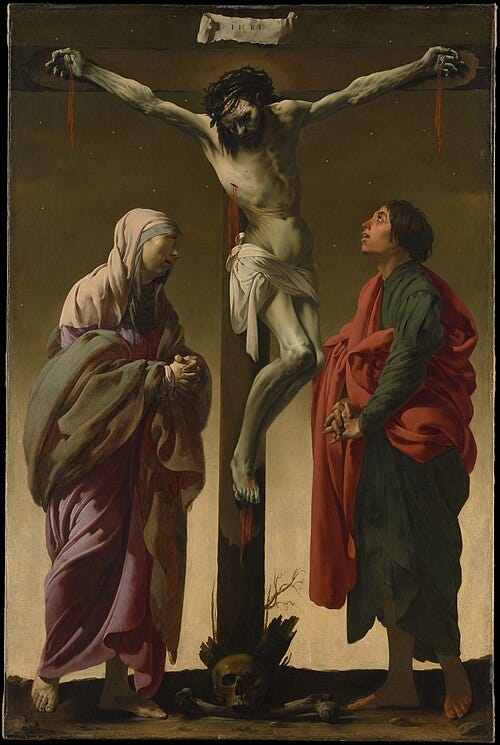
And so we arrive at Good Friday. Out of all the days in the Church Year, Good Friday is the only day where no Mass is said. While there is a liturgy for today, a simple prayer service, there is no fresh consecration of bread and wine—no liturgical sacrifice.2 This is because the Church keeps silence as her Lord is led to the Holy Cross to be crucified. We see Him who our sins have pierced and mourn with St. John and Our Lady at the foot of the Cross, processing the grave implications of what is happening. On this sorrowful second day of the Holy Triduum, a day we as a Church dare to call “good,” humanity as a whole has put Jesus to death. Our sins placed Him there. And though in agony, Jesus gladly tastes death for every man. As the Sacred Author in Hebrews will put it, Christ, “for the joy that was set before him[,] endured the cross.”3
There are more readings than usual for today, so I will treat each one as briefly as possible.
In our first lesson from Hosea, the Passion of the Lord is prophesied. It is written that, “He will revive us after two days: on the third day He will raise us up and we shall live in His sight.” Further, it is revealed that mercy is God’s true aim, with the Almighty saying, “I desired mercy and not sacrifice, and the knowledge of God more than holocausts.” Because mercy is to prevail, God will give His only Son to be ultimate sacrifice—a holocaust that can never be topped. For only the Son of God can offer something of infinite value back to God His Father. This sacrificial intervention—which ends any other sort of sacrifice beforehand—ransoms humanity from the curse of sin and wins endless mercy and forgiveness for those who desire it. Thus will be proved true Our Lords words: “For God sent the Son into the world, not to condemn the world, but that the world might be saved through him.”4
The second lesson for today in Exodus spells out the process of the Passover for those under the Old Covenant. The Jews were to find a spotless lamb and kill it. With the blood of this animal, it was commanded that they were to “apply it to the two doorposts and the lintel of every house.” Then the lamb was to be “roasted whole.” And then eaten. Everything concerning the lamb was to be consumed as much as possible; and anything remaining to be burnt. Our Lord Jesus, of course, is the Lamb of God.5 He was Innocence itself. He had no sin in Him. He willingly submitted Himself as an offering for sin to redeem man, to repair the seemingly irreparable gulf between God and man. As St. Paul writes, “For our sake he [the Father] made him [Jesus] to be sin who knew no sin, so that in him we might become the righteousness of God.”6
As for our narrative of the Passion found in St. John’s Gospel? It is difficult to know what to focus on. However, I am led to the piercing of Christ’s side. After Our Blessed Lord had endured so much torturous cruelty on our behalf, He still had a gift for the Church post-mortem. The Roman soldiers, in order to verify that He had truly expired, “opened His side with a lance, and immediately there came out blood and water.” This liquid likely came from the stressed pericardial sac which surrounded the human heart of Jesus. Our Lord’s Sacred Heart, which had stopped beating, still provided, in excess, His Precious Blood for His Bride. Only one prick of His Blood was enough to redeem mankind, but Jesus gave of Himself superabundantly. Many commentators will analyze the blood and water issuing forth from His side and see them as types of the Sacraments (Eucharist for the blood and Baptism for the water). Such Sacraments are initiatory in the life of a Christian—introducing their souls to new life and sustaining it. The medieval Christians especially thought of this special wound of Christ as a sort of canal which gives birth to the Church.7 Indeed, how wonderful is the Lord in giving of Himself to the uttermost in this way!
The Earth itself reacted two thousand years ago with earthquakes and darkness when Christ died. Saints rose from the dead and walked around. People fled for fear of their lives. The curtain of the Holy of Holies in the Jewish Temple was torn in two. All these years later, however, mankind barely notices the Cross in contrast. We’ve become accustomed to it. We’ve sanitized it. We barely even remember that the Roman cross was an instrument of execution. Let us not fall into such unfortunate and ungrateful amnesia. Today, let remember that the Sacred Body of the Son of God hung on the Cross for us—pinned to the wood by nails. Let us adore Him there. Let us unite our hearts to His perfect offering and thus, by His grace, be saved from every kind of evil—especially our own. In so doing, may we take the rest of this day to quiet the interior of our hearts from distraction and thus render all homage to the Crucified King of Glory.
Behold the wood of the cross, on which is hung our salvation! Come, let us adore!
Scripture readings from the traditional Roman lectionary were taken from the Saint Andrew Daily Missal, Regular Edition published in 1956.
After the reforms of Pius XII, there is a communion service on Good Friday—laity were allowed to receive that which consecrated the night before on Holy Thursday. Those surplus hosts are kept in reserve. Beforehand in the West, only the priest could have received anything consecrated the night prior. This sacramental fast of the laity, as it were, emphasized that Christ indeed gave His total self in the immolation of the Cross on Good Friday.
Hebrews 12:2, RSVCE.
John 3:17.
John 1:29.
The next day he [John the Baptist] saw Jesus coming toward him, and said, “Behold, the Lamb of God, who takes away the sin of the world!”
II Corinthians 5:21.
Which is why, in medieval art, sometimes the pierced side, when isolated, looks like a lady’s womanhood. It highlights the maternal character of Christ in birthing the Church in His Passion. For more reading on this see this book: Jesus through Medieval Eyes: Beholding Christ with the Artists, Mystics, and Theologians of the Middle Ages by Grace Hamman.