
Lent: Ember Wednesday
God desires communion with us and that we be in His Family, the Church.

Scripture Readings
Epistle.1 Exodus 24:12-18.
In those days the Lord said to Moses: “Come up to Me into the mount, and be there; and I will give thee tables of stone, and the law, and the commandments which I have written: that thou mayest teach the children of Israel.” Moses rose up, and his minister Josue: and Moses going up into the mount of God, said to the ancients: “Wait ye here till we return to you. You have Aaron and Hur with you: if any question shall arise, you shall refer it to them.” And when Moses was gone up, a cloud covered the mount, and the glory of the Lord dwelt upon Sinai, covering it with a cloud six days: and the seventh day He called him out of the midst of the cloud. And the sight of the glory of the Lord was like a burning fire upon the top of the mount, in the eyes of the children of Israel. And Moses, entering into the midst of the cloud, went up into the mountain: and he was there forty days and forty nights.
Gospel. Matthew 12:38-50.
At that time, certain of the Scribes and Pharisees answered Jesus, saying, “Master, we would see a sign from Thee.” But He answered and said to them: “An evil and adulterous generation demands a sign, and no sign shall be given it but the sign of Jonas the prophet. For even as Jonas was in the belly of the fish three days and three nights, so will the Son of Man be three days and three nights in the heart of the earth. The men of Ninive will rise up in the judgement with this generation and will condemn it; for they repented at the preaching of Jonas, and behold, a greater than Jonas is here. The queen of the South will rise up in the judgment with this generation and will condemn it; for she came from the ends of the earth to hear the wisdom of Solomon, and behold, a greater than Solomon is here. But when the unclean spirit has gone out of a man, he roams through the dry places in search of rest, and finds none. Then he says: ‘I will return to my house which I left’; and when he has come to it, he finds the place unoccupied, swept and decorated. Then he goes and takes with him seven other spirits more evil than himself, and they enter in and dwell there; and the last state of that man becomes worse than the first. So shall it be with this evil generation also.” While He was still speaking to the crowds, His mother and His brethren were standing outside, seeking to speak to Him. And someone said to Him: “Behold, Thy mother and Thy brethren are standing outside, seeking Thee.” But He answered and said to him who told Him: “Who is My mother and who are My brethren?” And stretching forth His hand towards His disciples, He said, “Behold My mother and My brethren! For whoever does the will of My Father in heaven, he is My brother and sister and mother.”
Reflection
Today is the first in the Lenten series of Ember Days. In a week that contains the Ember Days, the Christian will spend Wednesday, Friday, and Saturday praying more intensely for vocations to the priesthood. The Catholic encounters Ember Days four times during the liturgical year: firstly during Advent the week after the feast of St. Lucy, secondly the week after Ash Wednesday in Lent, thirdly after Pentecost Sunday, and finally the week after the feast of The Exaltation of the Holy Cross. A simple and fun mnemonic to remember this in a succinct manner is: “Lenty, Penty, Crucy, Lucy.” Sadly, Ember Days are no longer universally binding on Christians in the Latin church; however, some communities in communion with the Catholic Church—like the Anglican Ordinariates, for example—still practice them as a penitential obligation. I am reflecting upon the readings for these days because I very much want the Ember Days to return to West and be practiced by all faithful Latin Catholics therein. Writing these articles is my way of shedding light on them so that others may know they exist.
That said, let’s reflect on the readings!
In the epistle reading taken from Exodus, the Lord calls Moses unto Himself. He wants to impart the Law and the tablets which are inscribed with the Ten Commandments. Moses takes Joshua with him and intends meet God at Mt. Sinai. As he does so, we are told that “a cloud covered the mount, and the glory of the Lord dwelt upon Sinai, covering it with a cloud six days[.]” There was a period of waiting before Moses could approach the Lord, but on the seventh day, God “called him out of the midst of the cloud.” At this moment onlookers took in “the sight of the glory of the Lord” which “was like a burning fire upon the top of the mount[.]” And Moses then went “into the midst of the cloud” to converse with Almighty God. And he did so for “forty days and forty nights.”
What we can glean from this is that God is always calling us to Him. In prayer, the fact that we do pray is result of God’s initiative. He beckons us to Him—giving us the graces necessary to enable our very prayer itself. Even when our prayer seems fruitless, we should follow through on even the smallest spark of desire within us to pray. For when we do, it is safe to say that we are actually obeying the promptings of the Triune God. In this ongoing dialogue with the Divine, we Christians find constant nourishment for our souls.
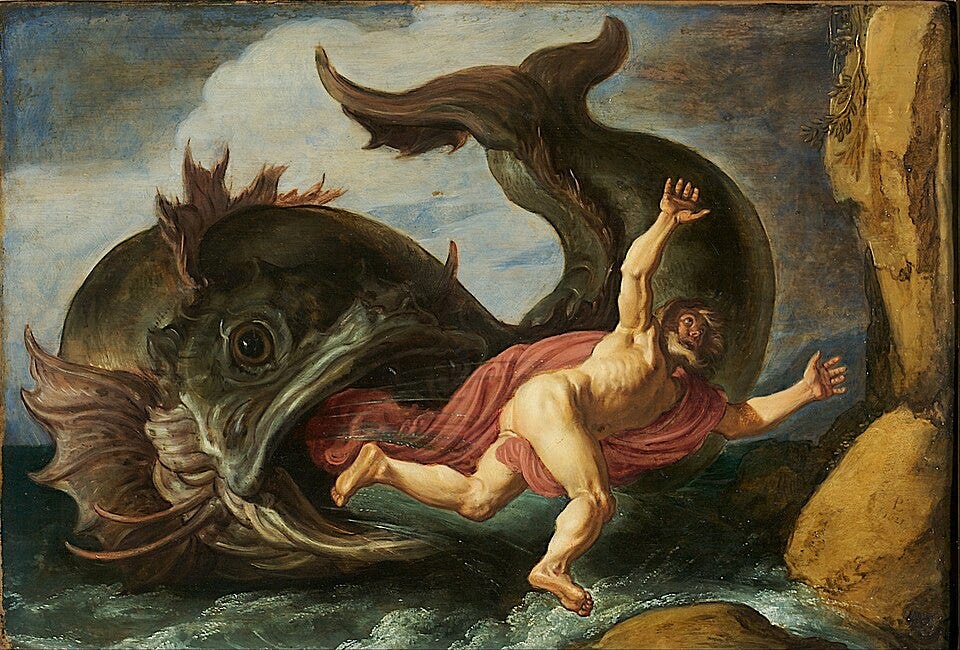
Turning to our gospel reading in St. Matthew, we see the Jews demand a sign from Christ. But the Blessed Lord turns their desire back on them, saying, “An evil and adulterous generation demands a sign, and no sign shall be given it but the sign of Jonas the prophet.” To make such an allusion is curious. Our Lord explains further: “For even as Jonas was in the belly of the fish three days and three nights, so will the Son of Man be three days and three nights in the heart of the earth.” Here Jesus refers to His future entombment and conquering of death, in which His human body shall lie dead for three days only to Rise again in victory via the Resurrection.
For us who may have heard of Jonah in Sunday School and watched the VeggieTales movie, we might not automatically equate this Bible story with death. But it is important to note that when Jonah was in the belly of that aquatic behemoth—whether a “great fish”2 or a whale—he was deceased. He wasn’t just twiddling his thumbs or slinging around some seaweed for the fun of it. No, he had expired and his soul had gone down to Sheol—the realm of the dead.3 That is why the prophet prays in his post-mortem state the following:
“I called to the Lord, out of my distress,
and he answered me;
out of the belly of Sheol I cried,
and thou didst hear my voice.
For thou didst cast me into the deep,
into the heart of the seas,
and the flood was round about me;
all thy waves and thy billows
passed over me.
Then I said, ‘I am cast out
from thy presence;
how shall I again look
upon thy holy temple?’
The waters closed in over me,
the deep was round about me;
weeds were wrapped about my head
at the roots of the mountains.
I went down to the land
whose bars closed upon me for ever;
yet thou didst bring up my life from the Pit,
O Lord my God.
When my soul fainted within me,
I remembered the Lord;
and my prayer came to thee,
into thy holy temple.
Those who pay regard to vain idols
forsake their true loyalty.
But I with the voice of thanksgiving
will sacrifice to thee;
what I have vowed I will pay.
Deliverance belongs to the Lord!”4
When God in His mercy hears the prayer of Jonah, He restores life back unto the prophet in this way: “[T]he Lord spoke to the fish, and it vomited out Jonah upon the dry land.”5
Jesus, therefore, tells the Jews in a biblical way that He is going to be like Jonah in that He is going to come back from death itself; He prophesies His own Resurrection. He then tells them that many people will condemn them for not believing in Him because of this sign—everyone from the men of Nineveh who received Jonah’s message of repentance to the Queen of Sheba who had sought out Solomon’s wisdom. These people of biblical times past had seen great signs and wonders, but the Resurrection? That was perhaps the greatest miracle of all. And the Jews would bypass this sign for which Christ had come from Heaven to show us.
The confounding of the Jewish teachers presents unto us a principle of unbelief and spiritual emptiness to avoid. Thus Our Lord further illustrates in today’s reading of the demon who departs a soul only to come back and find the soul “unoccupied, swept and decorated.” With a lack of belief in God’s promises and His infused supernatural virtues, the Evil One has room to abide in our hearts. Thus, the original demon, seeing that his old abode is vacant for residence, “takes with him seven other spirits more evil than himself, and they enter in and dwell there[.]” We do not want to be in that circumstance. We want our hearts to be full with the good things of God.
When Our Lord had concluded, someone let Him know that His mother and brethren were seeking Him out. Jesus, while gesturing toward His listeners: “Behold My mother and My brethren! For whoever does the will of My Father in heaven, he is My brother and sister and mother.” By saying this, the Blessed Lord is not dissing His family, especially His mother; rather, He is praising her by making her initial act of faith a universal requirement in being part of the Family of God. Our Lady had heard the Angel’s proposition of what God had planned to do through her and she simply replied, “[L]et it be to me according to your word.”6 Now all of us, in order to be related to the Word of God Incarnate, just need to follow through on what the Lord asks of us. If we do so, we shall, by grace, reap rewards eternal. That Marian spirit is one we must all imitate, for it is the filial spirit of a Christian. Whatever the Almighty asks of us, let us not waffle or dilly-dally in our response, but simply give Him this word: Fiat—Let it be.
As we move along in this Lenten season, and as we fast this Ember week in petition for holy priests to help build up the Church Militant, let us never lose sight of that fact that God desires communion with us—for us to be related to Him as a part of His Family. May our fasts, our meditations, and our prayers all be a way of saying “Let it be” unto God. For the Lord’s mercy is great and His grace is powerful to save; saying “Yes” to Him is least we could do for all the wonders He has done for us. It is such a privilege to know the One who has created all things “in heaven and on earth, visible and invisible, whether thrones or dominions or principalities or authorities—all things were created through him and for him.”7 May He keep us faithful to Him now and always.
O Lord, grant us many holy priests!
Scripture readings from the traditional Roman lectionary were taken from the Saint Andrew Daily Missal, Regular Edition published in 1956.
Jonah 1:17, RSVCE.
For a more detailed version of this understanding of Jonah’s fate and its link to Christ’s Resurrection, I recommend reading Dr. Brant Pitre’s book, The Case for Jesus: The Biblical and Historical Evidence for Christ.
Jonah 2:2-9.
Jonah 2:10.
Luke 1:38.
Colossians 1:16.